Is Your Website Ready for AI Search?
Evergreen audits your site across 50+ factors that determine whether AI systems can discover, understand, and cite your content — then gives you a scored action plan to improve.
What you get
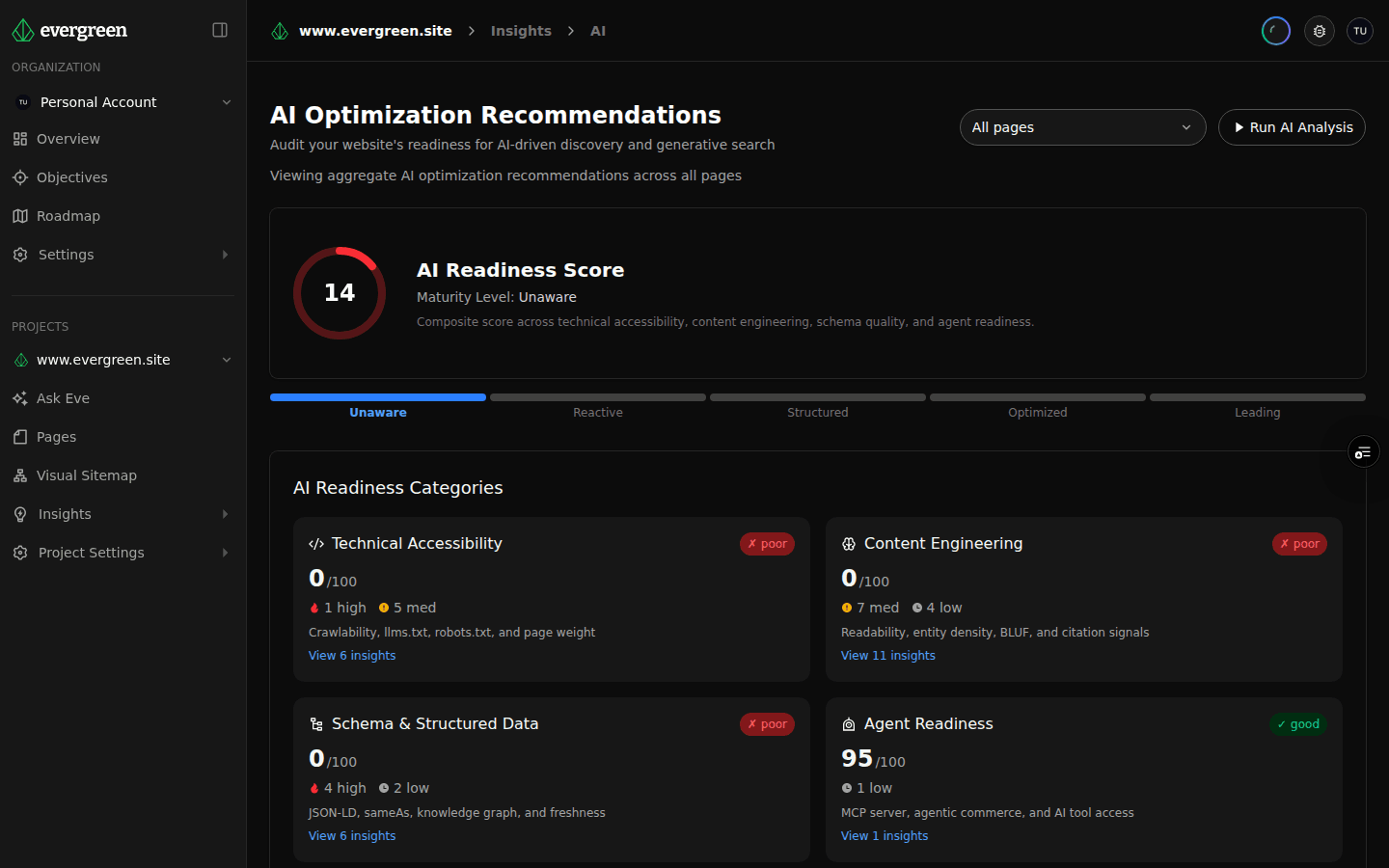
AI Readiness Score
Get a composite score from 0 to 100 that tells you exactly how prepared your site is for AI-driven discovery, with a clear maturity level from Unaware to Leading.
Technical Accessibility Audit
Check llms.txt, AI crawler permissions, page weight, JavaScript dependency, and meta directives — the infrastructure that determines whether AI systems can even reach your content.
Content Engineering Analysis
Evaluate entity density, direct answer patterns, citations, authorship signals, and readability metrics tuned for AI parsing efficiency.
Schema & Structured Data
Validate JSON-LD, @id disambiguation, sameAs knowledge graph links, knowsAbout expertise declarations, and dateModified freshness signals.
Agent Readiness Check
Verify MCP server presence and AI-specific crawler configurations so your content is accessible to the next generation of AI agents and tools.
Prioritized Action Plan
Every finding is ranked by priority — high, medium, or low — so you know exactly which changes will have the biggest impact on your AI visibility.
The Visibility Landscape Has Changed
In 2026, a growing share of search traffic flows through AI-generated answers. When someone asks ChatGPT, Claude, Perplexity, or Google's AI Overview a question about your industry, your brand is either included in the response or it does not exist for that query.
This is not a future trend to prepare for. It is happening now. Answer Engine Optimization (AEO) and Generative Engine Optimization (GEO) are the disciplines that determine whether your content gets retrieved, cited, and recommended by AI systems.
Evergreen's AI Insights feature audits your website across four scoring categories and 50+ individual factors, then produces a composite AI Readiness Score with a prioritized action plan.
What Evergreen Analyzes
Technical Accessibility (30% of score)
The infrastructure layer. If AI crawlers cannot access your content, nothing else matters.
- llms.txt — Whether you have a structured summary file that tells AI systems what your site is about, who you are, and what your expertise covers.
- AI crawler permissions — Whether your robots.txt allows or blocks GPTBot, ClaudeBot, PerplexityBot, OAI-SearchBot, Amazonbot, and other AI crawlers.
- Page weight and JS dependency — AI systems prefer lightweight, content-rich pages. Heavy JavaScript frameworks that require client-side rendering are harder for AI crawlers to process.
- H1 structure and meta directives — Clear heading hierarchy and proper meta tags help AI systems parse your content structure.
Content Engineering (30% of score)
The quality and structure of your content determines whether AI systems can extract facts and cite your work.
- Entity density — The optimal range is roughly 20% proper nouns (names, places, products, technical terms). Content with high entity density is more likely to be cited because it contains specific, verifiable facts rather than generic statements.
- BLUF pattern — Bottom Line Up Front. Pages that lead with a direct, concise answer to the core question are more likely to be pulled into AI-generated responses.
- Statistics and data points — Content that includes specific numbers, percentages, and research findings gives AI systems citable evidence.
- Expert quotations and authorship — Clear attribution signals (author bios, credentials, quoted experts) increase trust signals for AI citation.
- Readability metrics — A Flesch score of 60-70 and Gunning Fog of 8-10 balances depth with parsing efficiency. Overly complex or overly simple content gets ranked lower.
- AI-ism detection — Generic phrases like "rapidly evolving landscape" or "in today's world" signal low-value content. Evergreen flags these patterns so you can replace them with specific, substantive language.
Schema & Structured Data (25% of score)
Structured data is how your content connects to the knowledge graph — the shared understanding that AI systems use to verify and contextualize information.
- JSON-LD presence and validity — Proper schema markup helps AI systems understand what your content is about at a machine-readable level.
- @id disambiguation — Unique identifiers that connect your entities to the broader web of knowledge.
- sameAs knowledge graph links — Links to Wikipedia, Wikidata, and other authoritative sources that verify your entities exist in the knowledge graph.
- knowsAbout expertise declarations — Schema properties that explicitly declare your areas of expertise, helping AI systems match your content to relevant queries.
- dateModified freshness — AI systems prefer recent content. Pages not updated within 60 days receive lower freshness signals.
Agent Readiness (15% of score)
The emerging layer. AI agents (not just search) are starting to interact with websites programmatically.
- MCP server presence — Whether your site exposes data via the Model Context Protocol, making your content available to AI coding tools, research assistants, and workflow agents.
- AI-specific crawler configurations — Fine-grained control over which AI systems can access which parts of your site.
Maturity Levels
Your composite score maps to a maturity level that tells you where you stand:
- Leading (81-100) — Your site is optimized for AI discovery and citation. You are ahead of most competitors.
- Optimized (61-80) — Strong foundation with room for improvement in specific areas.
- Structured (41-60) — Basic elements are in place but significant gaps remain.
- Reactive (21-40) — Minimal AI readiness. Your content is likely invisible to most AI systems.
- Unaware (0-20) — No AI optimization in place. Immediate action needed.
How to Use the Results
Every insight Evergreen generates includes a priority level (high, medium, or low) and is grouped by subcategory. Start with the high-priority items in Technical Accessibility — these are the foundation. Then work through Content Engineering improvements, add structured data, and finally address Agent Readiness.
Run another analysis after making changes to track your progress. Your AI Readiness Score updates with each analysis, so you can demonstrate improvement to clients and stakeholders over time.
Better Together
AI Insights work alongside the rest of the Evergreen platform. Use the content audit to fix foundational SEO issues first, connect GA4 and Search Console to see which pages are already getting AI-driven traffic, and generate a shareable report that combines traditional SEO scores with AI readiness data.
Get Your AI Readiness Score
Enter your URL, run an AI analysis, and see exactly where your site stands. No credit card, no setup — just a clear score and a prioritized action plan.
Ready to try it yourself?
Start with a free account and see what Evergreen can reveal about your website in minutes.
Get Started Free →No credit card required. Just insights.